Getting a referral for a bone scan is one thing. Knowing exactly what to do next is another. Many patients across Southern Ontario receive their referral and then spend days trying to figure out which clinic to call, what documents to bring, and whether their scan is even covered by OHIP. The process feels more complicated than it should, especially when different types of bone scans exist and provincial rules around coverage have recently changed. This guide walks you through every step, from understanding your referral to confirming your appointment, so you can move forward with confidence and as little delay as possible.
Table of Contents
- Understanding your bone scan referral
- What you’ll need before booking
- Step-by-step: How to book your bone scan appointment
- Verifying and preparing for your appointment
- What most guides miss about booking bone scans in Ontario
- Need a bone scan or other diagnostic imaging?
- Frequently asked questions
Key Takeaways
| Point | Details |
|---|---|
| Clarify scan type first | Knowing your referral and scan type ensures you contact the right clinic and avoid delays. |
| Prepare documents | Have your referral, health card, and all forms ready to speed up booking. |
| Compare wait times | Check hospital, clinic, and private options to find the shortest possible appointment window. |
| Confirm eligibility | Know the latest OHIP rules and ask about exceptions for high-risk or urgent cases. |
Understanding your bone scan referral
To start any booking, it’s essential to know exactly what your doctor has ordered. Not all bone scans are the same, and mixing up the types can lead to booking the wrong test entirely.
A BMD scan (bone mineral density scan, also called a DEXA scan) uses low-dose X-ray technology to measure bone strength. It is the standard screening tool for osteoporosis and is commonly ordered for women over 65, men over 70, or anyone who has experienced a fragility fracture. A nuclear bone scan, on the other hand, uses a small amount of radioactive tracer to highlight areas of abnormal bone activity. It is typically ordered to investigate bone infections, cancer spread, stress fractures, or unexplained bone pain. These two tests are very different in purpose, technology, and coverage, as shown below.
| Test type | Purpose | Technology | OHIP coverage |
|---|---|---|---|
| BMD/DEXA scan | Osteoporosis screening | Low-dose X-ray | Yes, with frequency limits |
| Nuclear bone scan | Cancer, infection, fracture detection | Radioactive tracer | Yes, with referral |
| Bone X-ray | Fracture or structural assessment | Standard X-ray | Yes, with referral |
Understanding the bone scan vs X-ray distinction matters because your preparation, wait time, and facility options will differ based on which test you need.
Before you call any clinic, ask your doctor these questions:
- What type of bone scan did you order (BMD/DEXA or nuclear)?
- Is there a specific urgency level on the referral?
- What condition or symptom is the scan investigating?
- Are there any prep instructions I should follow before the scan?
- Am I eligible for earlier testing based on recent fracture or high-risk status?
This last question is especially important right now. BMD testing in Ontario is distinct from nuclear bone scans and carries OHIP frequency limits that changed in 2026. High-risk patients, including those with a recent fracture, may qualify for earlier repeat testing, but you need to confirm this directly with your physician.
Pro Tip: Ask your physician to clarify in writing whether you qualify for an earlier BMD test based on a recent fracture or high-risk diagnosis. This documentation can help you avoid coverage disputes when you call to book.
What you’ll need before booking
Once you know your scan type, make sure you have everything ready before reaching out to a clinic. Showing up unprepared, even just to make a phone inquiry, can slow down your booking significantly.
Here is what most clinics will ask for:
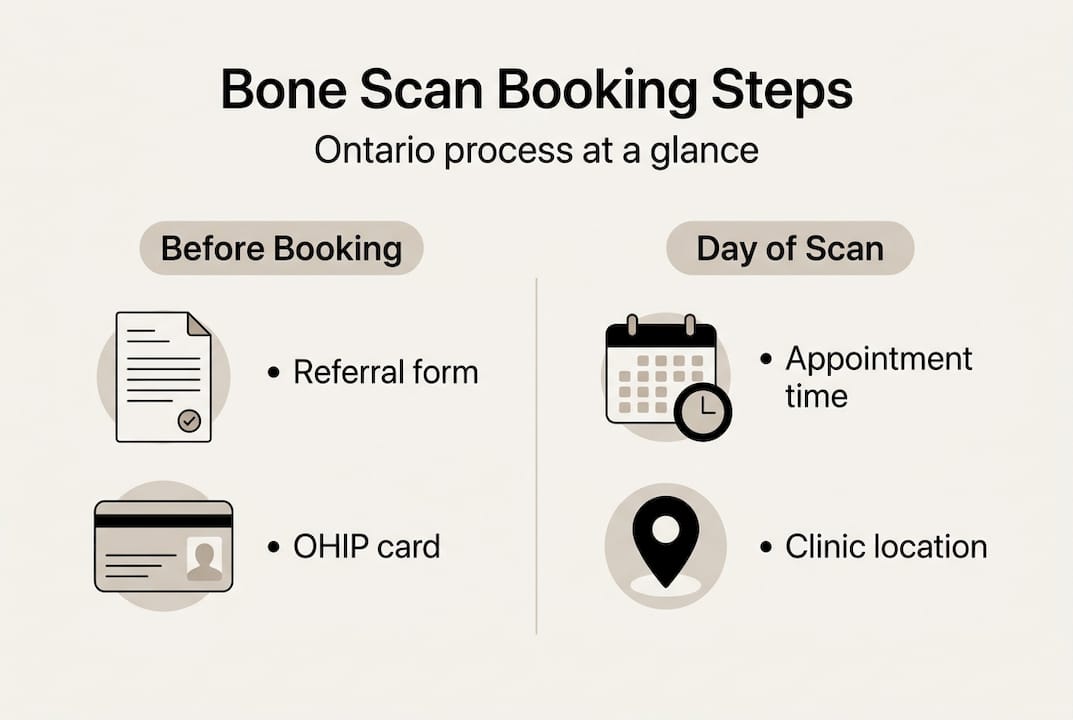
- Physician referral form: This must clearly state the type of scan ordered and the clinical indication.
- Ontario health card (OHIP card): Required for publicly funded scans. Make sure it is not expired.
- Valid government-issued photo ID: A driver’s license or passport works.
- Medication list: Some scans require you to pause certain medications beforehand, so having this ready speeds up the intake process.
- Previous imaging records: If you’ve had a prior BMD or bone scan, bring those results or know where they are stored.
For most patients, OHIP covers bone scans when a valid referral is provided. However, public health coverage has specific eligibility rules, and not every scan is automatically approved. If you do not meet OHIP criteria, private options are available at some clinics, which can offer faster access but come with out-of-pocket costs.
Wait times are a real concern in Ontario. Wait times vary by clinic and urgency level, and Ontario Health does not track bone scan waits separately from other diagnostic imaging. This means you may need to call multiple clinics to compare availability. Community clinics and private imaging centers often have shorter wait times than hospital-based facilities.
Pro Tip: Before you book, call the clinic directly and confirm they have your referral type on file, that your health card is accepted, and that they have your preferred appointment window available. This single call can save you days of back-and-forth.
Step-by-step: How to book your bone scan appointment
Now you’re ready to schedule your scan. Let’s break down each step so nothing gets missed.
- Confirm your referral details. Read your referral form carefully. Verify the scan type, the ordering physician’s information, and any urgency flags. If anything is unclear, call your doctor’s office before proceeding.
- Identify eligible clinics. Not every imaging center performs every type of bone scan. Hospitals, community clinics, and private imaging centers all offer different services. Search for facilities near you that specifically offer BMD or nuclear bone scanning.
- Compare wait times. Use the Ontario wait times resource as a starting point. While bone scan waits aren’t tracked separately, this tool helps you identify which facilities are managing volume better overall.
- Book your appointment. Call the clinic directly, book online if available, or ask your doctor’s office to send the referral electronically. Some clinics offer booking appointments near you through online portals, which can speed up the process. A few facilities also offer walk-in screening options for select services.
- Confirm prep instructions. Before you hang up, ask about fasting requirements, medication restrictions, and what to wear. Nuclear bone scans, for example, typically involve a tracer injection followed by a waiting period before imaging begins.
| Booking approach | Typical wait time | OHIP coverage | Notes |
|---|---|---|---|
| Hospital-based | Longer (weeks to months) | Yes | Best for urgent or complex cases |
| Community imaging clinic | Moderate (days to weeks) | Yes | Often faster, more accessible |
| Private imaging center | Shortest (same day to days) | Partial or none | Out-of-pocket cost may apply |
Important: Missing paperwork or failing to confirm your OHIP eligibility before your appointment can result in cancellation or unexpected costs. Double-check every document before your scheduled date.
Verifying and preparing for your appointment
With your appointment secured, make sure nothing catches you off guard on the day of your scan.
Run through this checklist in the 24 to 48 hours before your appointment:
- Confirm the date, time, and exact clinic location (not just the street address, but the floor or suite number).
- Review any fasting instructions. BMD scans typically require no special prep, but nuclear bone scans may require you to avoid certain foods or supplements.
- Check whether you need to hold any medications. Calcium supplements, for example, are sometimes paused before a DEXA scan.
- Arrange transportation if needed, especially if you’re receiving a nuclear scan that involves a tracer injection and a waiting period of two to four hours before imaging.
- Bring all required documents: referral, health card, and ID.
If you need to reschedule, call the clinic as early as possible, ideally 48 hours in advance. Late cancellations can result in longer waits for a new slot.
After your scan, your results will typically be sent to your referring physician within a few business days. Follow up with your doctor to discuss findings and next steps. If you are a high-risk patient, ask specifically about your eligibility for future testing. BMD protocols in 2026 have changed, and some patients may need to advocate for earlier repeat testing if their condition warrants it.
For patients who fall into higher-risk categories, reviewing high-risk screening guidance can help you understand what additional options may be available to you.
Pro Tip: Write down any symptoms or changes you notice after your scan, especially if you received a nuclear tracer. Share this list at your follow-up appointment so your doctor has a complete picture.
What most guides miss about booking bone scans in Ontario
While the step-by-step covers the basics, let’s look at what really makes a difference behind the scenes.
Most online guides treat the booking process as static. The reality is that OHIP rules shift, and many articles are written once and never updated. Recent OHIP rule revisions have tightened screening intervals, frustrating both patients and providers who relied on older guidelines. If you’re reading a guide that doesn’t mention 2026 changes, treat its coverage information with caution.
High-risk patients face a specific challenge. OHIP may not automatically approve earlier BMD testing, even when a patient has recently fractured a bone. You may need to push your physician to document your high-risk status explicitly on the referral. This is not the system working against you; it’s a bureaucratic gap that requires patient advocacy to close. Reviewing special screening explained can give you a clearer sense of how to navigate these situations.
One rarely mentioned option: if your wait time at a public facility is excessive, ask directly about private imaging costs. For a BMD scan, the out-of-pocket cost at a private clinic is often more manageable than patients expect, and the time saved can matter clinically. Many delays also come down to small paperwork errors, a missing signature, an expired health card, or a referral that doesn’t specify the correct scan type. Check everything twice before you book.
Need a bone scan or other diagnostic imaging?
At Valence Medical Imaging, we’ve been serving Southern Ontario patients for over 35 years across seven clinic locations, including Toronto, Scarborough, Brampton, Bramalea, Niagara Falls, and Whitby. We offer bone density imaging, digital X-ray, ultrasound, and more, with short wait times and fast report turnaround. Our team makes booking straightforward, whether you prefer to call or book online. If you’re weighing your imaging options, our resources on X-ray vs MRI and digital X-ray advances can help you make informed decisions with your doctor. We’re here to make your diagnostic experience as smooth and stress-free as possible.
Frequently asked questions
What is the difference between a bone density (BMD/DEXA) scan and a nuclear bone scan?
A BMD/DEXA scan checks bone strength using low-dose X-ray, while a nuclear bone scan uses a small amount of radioactive material to detect bone abnormalities. BMD and nuclear scans differ significantly in technology, purpose, and OHIP restrictions.
Are there different wait times for bone scan appointments in Ontario?
Yes, wait times depend on your urgency level, scan type, and location. Wait times vary and are not specifically tracked for bone scans, so calling multiple clinics to compare is often the fastest approach.
Can I book a bone scan without a doctor’s referral?
Most bone scans require a physician’s referral for booking and OHIP coverage in Ontario. Some private clinics may accommodate self-referrals, but you will likely pay out of pocket.
How often can I get a bone density (BMD/DEXA) test in Ontario?
As of April 2026, OHIP covers high-risk BMD tests every 36 months, though exceptions apply for certain high-risk patients. Confirm your eligibility with your doctor, as BMD frequency limits have recently been updated.
What should I bring to my bone scan appointment?
Bring your physician referral, your Ontario health card, and a valid photo ID. Arriving with all documents ready helps avoid delays and ensures your appointment proceeds on schedule.
Recommended
- Where Can I Book an OBSP Appointment Near Me? | Ontario Breast Screening Guide – Valence Medical Imaging
- What’s the Difference Between a Bone Scan and an X-Ray? – Choosing the Right Test – Valence Medical Imaging
- Can You Walk In for OBSP Screening in Ontario? | Same-Day Mammogram Guide – Valence Medical Imaging
- What Is a Bone Density Test and Where Can I Get One in Brampton? – Valence Medical Imaging