

Waiting weeks for an ultrasound when your doctor needs answers quickly is one of the most frustrating experiences in Canadian healthcare. For patients across Southern Ontario, delays often come down to unclear referrals, fragmented booking systems, and outdated processes that have not kept pace with modern technology. For healthcare providers, the bottlenecks are equally real: incomplete requisitions, manual data entry errors, and slow turnaround that holds up diagnosis and treatment. This guide walks both patients and providers through a practical, step-by-step workflow that draws on the latest digital tools, regional scheduling realities, and evidence-based best practices to improve access, reduce wait times, and get results faster.
Table of Contents
- Preparing for efficient ultrasound scheduling
- Step-by-step: The modern ultrasound scheduling workflow
- Dealing with variable wait times: Regional realities in Southern Ontario
- Best practices for providers: Reducing errors and ensuring fast turnaround
- The future of ultrasound scheduling: Why 2026 could be a turning point
- Book smarter: How Valence Medical Imaging can optimise your ultrasound experience
- Frequently asked questions
Key Takeaways
| Point | Details |
|---|---|
| Digital solutions save time | Switching to e-referrals can reduce data errors and speed up ultrasound scheduling for everyone. |
| Wait times vary by region | Ultrasound access in Southern Ontario depends on location—urban centres often book quicker than rural clinics. |
| Preparation matters | Having the right documents and using modern systems ensures a smoother, faster appointment from start to finish. |
| Providers benefit from AI | Healthcare teams using AI-augmented workflows see fewer appointment mistakes and faster reporting. |
Preparing for efficient ultrasound scheduling
With an understanding of the challenges, let’s get organised for a smoother experience.
Efficient ultrasound scheduling starts well before anyone picks up a phone or clicks a booking link. The preparation phase is where most delays are born and where the greatest gains can be made. For patients, this means having the right information and documents ready at the time of referral. For clinics and referring providers, it means adopting standardised intake processes and digital tools that eliminate the back-and-forth that slows everything down.

What patients and providers need to have ready
Before a referral is submitted or an appointment is booked, both sides of the process need to be organised. Patients should gather the following before their physician submits a referral:
- Valid Ontario health card (with current address and expiry date confirmed)
- Referring physician’s name, contact number, and fax number
- Relevant clinical history, including prior imaging reports, lab results, or specialist notes
- Specific symptom details to help the imaging centre triage the request appropriately
- Preferred appointment dates and location, particularly if travelling from a rural area
Providers, on their end, should ensure that referral forms include complete data fields, including the clinical indication, the specific exam requested, the patient’s relevant history, and the urgency level. Incomplete referrals are one of the most common causes of scheduling delays, leading to unnecessary phone calls, faxes, and resubmissions.
The role of digital requisitions
Standardised digital requisitions have been shown to significantly reduce input errors and processing delays. Novari Health’s MIRM and eRequest technologies are now live at Southlake Health and Niagara Health in Southern Ontario, centralising requisition intake, automating triage workflows, and integrating with EHR systems like Oracle Health to reduce manual work using AI-powered document processing. Traditional paper referrals create inefficiencies that digital solutions like Novari MIRM actively address by improving triage accuracy and communication for faster turnaround.
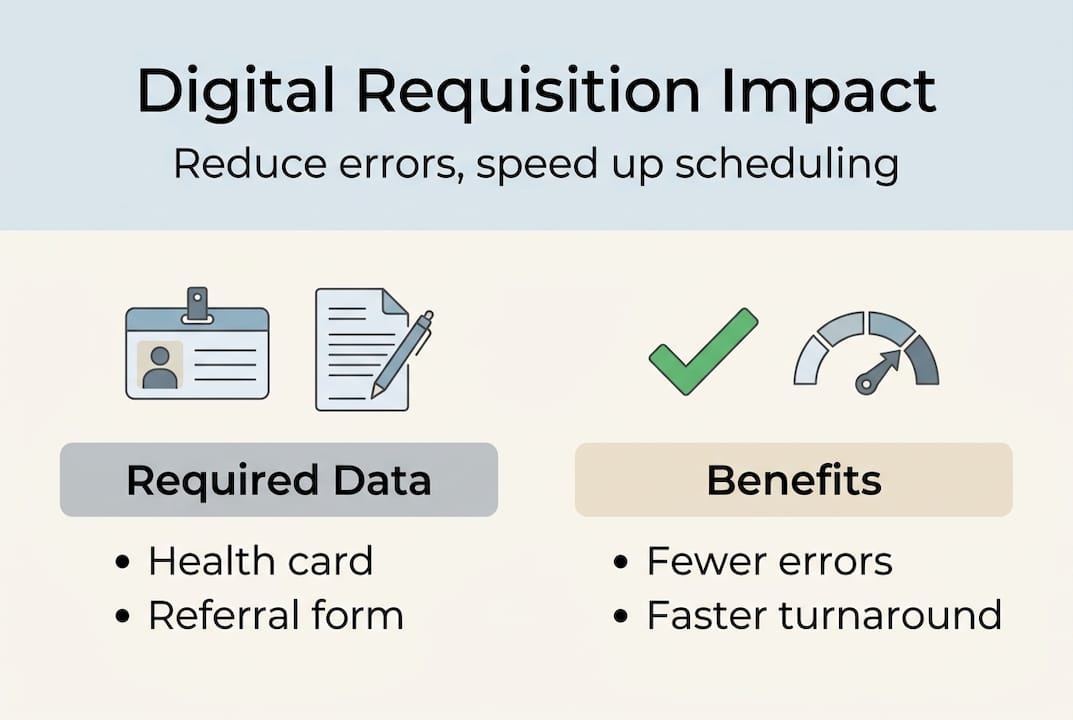
| Item | Details required | Recommended tool |
|---|---|---|
| Patient identification | Health card number, DOB, full name | EHR or patient portal |
| Referral form | Clinical indication, exam type, urgency | Digital e-request system |
| Prior imaging | Previous reports and images | Digital image sharing platform |
| Provider contact | Physician name, fax, phone | Standardised referral template |
| Appointment preference | Location, date range, accessibility needs | AI-powered call management or online portal |
Pro Tip: Double-check all referral fields before submission. Using a centralised e-request system where available reduces callbacks and re-submissions by ensuring all required data is captured the first time.
Step-by-step: The modern ultrasound scheduling workflow
Once you’re prepared, here’s how the scheduling process unfolds in leading clinics.
Understanding the sequence of steps from referral to exam day helps both patients and providers anticipate what comes next and act on it promptly. Modern clinics that have adopted digital workflows move through this process significantly faster than those still relying on paper and phone.
The scheduling sequence, step by step
- Physician submits a referral. The referring provider sends a completed requisition via a digital e-request system, fax, or in-person delivery. Digital submissions are processed faster and with fewer errors.
- Imaging centre receives and reviews the request. Staff or an automated system reviews the requisition for completeness. Incomplete referrals are flagged immediately, and the provider is contacted for missing information.
- Triage and prioritisation. The request is categorised by urgency. Urgent cases are scheduled within days; routine cases are placed in the standard queue.
- Patient contact and appointment booking. The patient is contacted by phone, email, or through an online portal to confirm availability and book a time. Online booking vs. call centre scheduling each carry distinct advantages depending on patient preference and clinic capacity.
- Appointment confirmation and preparation instructions. The patient receives written or digital confirmation, including any preparation instructions such as fasting requirements or clothing recommendations.
- Exam day check-in. The patient arrives with their health card, referral copy, and any required prep completed. Digital check-in systems reduce front-desk bottlenecks significantly.
- Exam completion and report generation. The sonographer performs the exam, and the report is generated and sent to the referring provider, typically within 24 to 48 hours at efficient clinics.
- Follow-up and results communication. The referring provider reviews the report and contacts the patient with next steps.
Traditional vs. digital workflow comparison
| Step | Traditional workflow | Digital workflow |
|---|---|---|
| Referral submission | Paper or fax | Electronic e-request |
| Intake review | Manual review, phone follow-up | Automated review, AI flagging |
| Appointment booking | Phone only | Online portal or phone |
| Confirmation | Mailed or verbal | Email, SMS, or patient portal |
| Report delivery | Faxed or mailed | Digital, same-day access |
Sonography Canada endorses CIHI MIS Standards for scheduling and time allotments, providing specific guidelines for examination durations that help clinics allocate appointment slots accurately and avoid overbooking. If you’re wondering about timing your imaging appointment, these standards ensure clinics reserve appropriate time per exam type, which protects both quality and efficiency.
Pro Tip: Confirm your appointment at least 24 hours in advance and bring all requested documents, including your health card, referral copy, and any prior imaging reports. Arriving prepared reduces check-in time and keeps the schedule on track for every patient that follows you.
Dealing with variable wait times: Regional realities in Southern Ontario
As you book, understanding the local landscape helps set expectations.
Wait times for diagnostic imaging in Southern Ontario are not uniform. They vary considerably depending on the clinic, the region, the urgency of the request, and whether the facility is a hospital or a private imaging centre. Understanding these differences helps you make informed decisions about where and when to book.
Why wait times differ across the region
Several factors contribute to the disparity in ultrasound wait times across Southern Ontario:
- Urban vs. rural location: GTA hospitals and clinics typically have more imaging equipment and staff, which can mean shorter waits. Rural and smaller-community sites often face longer queues due to limited resources.
- Type of facility: Hospital-based ultrasound units serve inpatients and emergency cases in addition to outpatient referrals, which can push non-urgent appointments further out. Private clinics focused on outpatient imaging often move faster.
- Urgency classification: How the referring physician codes the urgency of your referral directly affects when you’ll be seen. Routine referrals may wait weeks; urgent referrals are typically scheduled within days.
- Local demand: High-population areas like Brampton, Scarborough, and Toronto face greater demand, which can create backlogs even at well-resourced facilities.
Ontario tracks diagnostic imaging wait times through Ontario Health, but the system remains fragmented, with hospital-specific non-urgent waits posted inconsistently and ultrasound benchmarks not always broken out from general imaging data. Regional wait time disparities between GTA hospitals and rural Southern Ontario sites are well documented, with 2026 electronic referral coordination efforts planned to standardise queues and reduce fragmentation across the province.
“The system is very fragmented.” This characterisation from healthcare observers in early 2026 captures the core challenge: patients and providers often cannot find reliable, up-to-date information about where the shortest wait is for their specific exam.
Understanding city-by-city ultrasound access can help you make smarter decisions about where to book, particularly if you live near the border of two service areas. In some cases, booking at a clinic in a neighbouring city results in a significantly shorter wait.
Practical ways to minimise your wait locally
- Ask your physician about urgency coding. If your condition warrants it, an urgent classification can move your appointment ahead considerably.
- Consider private imaging clinics. Facilities like Valence Medical Imaging often offer same-day booking options for select services, bypassing the hospital queue entirely.
- Book across multiple locations. If you have flexibility, ask whether the clinic can accommodate you at a different branch with a shorter wait.
- Check the clinic’s website directly. Some facilities post current wait estimates online, which is faster than calling and waiting on hold.
- Follow up proactively. Cancellations happen. Letting the clinic know you are available on short notice can move you ahead in the queue if a slot opens up.
Best practices for providers: Reducing errors and ensuring fast turnaround
For clinics and referring providers, here are targeted ways to boost scheduling efficiency.
Healthcare providers play a decisive role in how quickly patients reach their ultrasound exam. The quality of the referral, the completeness of the clinical information, and the speed of follow-up all affect how smoothly the process flows. Adopting consistent best practices can eliminate most common bottlenecks.
Steps providers can take to streamline referrals and triage
- Use standardised digital referral templates. Standardised fields mean nothing is missed, and the imaging centre does not need to call back for clarification.
- Assign urgency levels consistently. Clear urgency coding ensures that triage staff at the imaging centre can prioritise correctly without needing to contact the referring office.
- Enable real-time status tracking. Digital platforms that allow providers to check the status of a referral in real time reduce the volume of follow-up calls.
- Leverage AI-powered intake tools. Automated document processing reduces transcription errors and speeds up the time from referral submission to appointment offer.
- Set up electronic report delivery. Ensure your office is configured to receive reports digitally so results are not delayed by fax or mail.
- Review turnaround benchmarks regularly. Tracking how long referrals take from submission to scheduled appointment helps identify recurring delays and address them proactively.
Research on dynamic resource allocation for ultrasound appointments found that online bookings rose to 81.42%, average appointment times were reduced by 78 to 90%, staff resources were saved, and patient wait time in the exam area dropped from 42 to 11 minutes. Exam volume increased 11.5% with fewer errors when digital scheduling platforms replaced manual processes. These are not marginal improvements. They represent a fundamental shift in how imaging departments can operate when the right tools are in place.
Pro Tip: Use standardised intake fields in your referral forms and enable real-time follow-up messaging through your clinic’s patient communication platform. These two changes alone can reduce the number of incomplete referrals by a significant margin and cut your average time-to-appointment considerably.
For providers managing high referral volumes, the key is not just speed but accuracy. A referral that reaches the imaging centre with complete clinical information the first time is worth far more than a rushed referral that requires three follow-up calls to clarify.
The future of ultrasound scheduling: Why 2026 could be a turning point
Beyond day-to-day steps, it’s worth asking: what will actually shift the dial in Ontario scheduling?
The honest answer is that incremental improvements, while helpful, will not close the care gaps that exist across Southern Ontario on their own. The regional disparity in wait times is structural. It is built into how referrals are routed, how queues are managed, and how information is shared or, more often, not shared between providers and facilities.
What 2026 represents is a moment of genuine potential. Province-wide e-referral systems and central imaging registries are beginning to come online in a more coordinated way than we have seen before. If implemented consistently, these tools could allow a physician in Whitby to see in real time that a clinic in Scarborough has a shorter wait for a specific exam and route the referral accordingly. That kind of visibility has simply not existed at scale until now.
AI-powered intake and scheduling tools are also beginning to level the field, particularly for sites in smaller communities that lack the administrative staff to manage complex referral queues manually. Understanding why wait times differ across Ontario cities is essential context for appreciating how much these technology investments matter at the local level.
The progress is real, but it requires consistent adoption. Clinics that invest in digital workflows today will be better positioned to serve their communities as the broader provincial system catches up.
Book smarter: How Valence Medical Imaging can optimise your ultrasound experience
Ready to put workflow steps into action? Here’s how you can make use of local resources right away.
Valence Medical Imaging has been serving Southern Ontario for over 35 years, and our seven clinic locations across Toronto, Scarborough, Brampton, Bramalea, Niagara Falls, and Whitby are designed to make the scheduling process as straightforward as possible. Whether you are a patient seeking a same-day appointment or a provider looking for efficient referral handling and fast report turnaround, we have the tools and the team to support you. Learn more about booking ultrasounds in Brampton or find answers to common exam questions by visiting our ultrasound FAQs for Niagara patients. Contact your nearest Valence location today to book your appointment with confidence.
Frequently asked questions
What documents do I need for an ultrasound appointment in Southern Ontario?
Typically, you’ll need a valid referral from your physician, your Ontario health card, and any previous imaging reports relevant to your condition. Standardised intake technologies like Novari MIRM centralise documentation requirements to reduce what gets missed at intake.
How can I find out the current wait time for an ultrasound at my local clinic?
Many hospitals post diagnostic imaging wait times online, but availability and detail vary considerably. Ontario’s wait time tracking does not always break out ultrasound specifically, so calling your clinic directly or checking their website is often the most reliable approach.
Are there real benefits to booking my ultrasound online instead of by phone?
Yes. Studies show that online bookings reached 81.42% adoption in digitised clinics, with appointment times dropping 78 to 90% and exam volume increasing 11.5%, all with fewer errors than phone-based systems.
How long does an average ultrasound take?
Standard ultrasound exams usually last 20 to 30 minutes, depending on the procedure and the body area being examined. Sonography Canada’s time guidelines provide specific duration benchmarks to help clinics schedule appointments accurately and protect exam quality.
Recommended
- How Long Do Ultrasound Results Take in Niagara Falls? A Complete Guide – Valence Medical Imaging
- How to Book an Ultrasound in Brampton – Same-Day Appointments Available – Valence Medical Imaging
- How Long Does an X-Ray Take? – Timing Your Imaging Appointment – Valence Medical Imaging
- How to Re-Schedule or Cancel Your OBSP Appointment Easily | Step-by-Step Guide – Valence Medical Imaging